





















Massage Face Cradle Fit: What to Adjust When You Lie Face Down
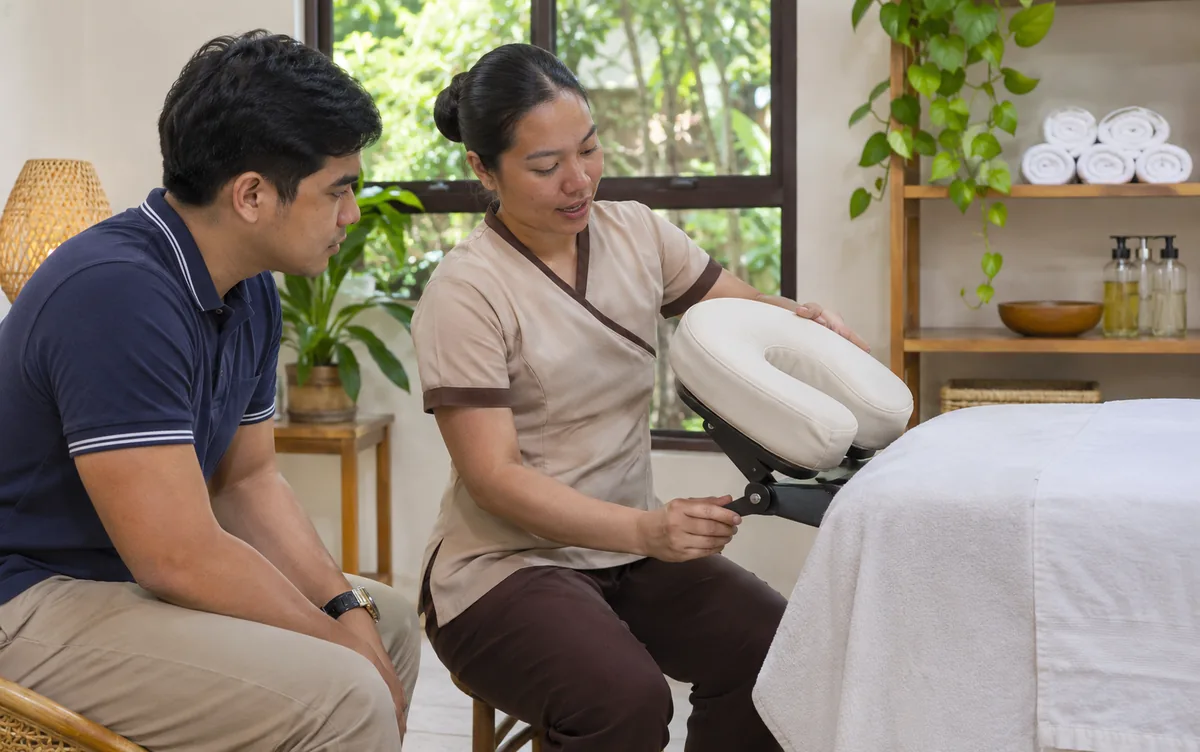
The first clue that your massage face cradle needs adjusting might be surprisingly small. You keep lifting your forehead a fraction of an inch, or your jaw is doing the work of keeping your face in place. Ask the therapist to pause before the massage gets going. A few moments spent finding a comfortable position are more valuable than half an hour spent hoping the cushion will feel better.
A face cradle is the padded, usually horseshoe-shaped support at the head of a massage table. Its opening gives your nose and mouth room while the surrounding cushion supports your face. Your job is to report how the fit feels. The therapist can handle the hardware and help you choose a different position if the available cradle doesn’t suit you.
Tell the difference between a fit problem and massage pressure
Suppose the therapist has barely touched your back, yet your glasses usually sit exactly where you’re feeling a hard edge. Saying “lighter, please” might get you a lighter back massage while leaving that edge in the same place. Point to the patch on your cheek or describe where the cushion meets your forehead. Words such as “bunched,” “slipping,” or “pressing close to my eye” give the therapist something to check.
A cushion can look centered from across the room and feel crooked to the person using it. The opening may be fine, while the disposable cover stretched across it is riding up toward your nose. Or the cover may sit smoothly while the whole platform feels too high. Let the therapist see the arrangement before you move, provided you’re comfortable staying there. If breathing feels restricted, lift your head and stop immediately.
Try the position before the therapist starts
Ask for a short trial with your clothes on if this is new to you. Rest rather than pushing your face into the padding. Notice whether you can breathe and speak freely and whether you find yourself bracing your neck. Have the therapist check the height, tilt, placement of the cushion, and the way its cover lies. There is no universal angle for every face or every table.
Change one thing and settle back down. If smoothing the cover clears your nose but your jaw still feels pushed up, say exactly that. The second piece of feedback preserves the adjustment that helped. For the broader conversation about asking for changes during a session, Spakol.net’s guide to communicating massage preferences includes ways to make a specific request without a lengthy explanation.
Recheck after your shoulders settle
An apparently good fit can change when you stop holding up your shoulders or move your forearms onto a shelf. The therapist may also notice that you keep turning your head to speak. Instead of repeating a whole intake conversation through the opening, sit up or turn to a position in which you can talk easily. Then decide whether another adjustment is worth trying.
A pillow-supported side position or a seated session may make more sense if the face support keeps bothering you. Ask which of your planned areas the therapist can work on in the new position. If the plan changes appreciably, settle the priorities before continuing. The wording in Spakol.net’s massage menu guide is useful when a booking promises full-body coverage but you want comfortable shoulder work above everything else.
What to say when the table has a fixed opening
Some tables have a cutout in the tabletop instead of a separate adjustable platform. The therapist may be able to change the padding or the way you’re positioned, but a fixed opening cannot be tilted like a hinged cradle. Ask what the actual table allows. Stacking loose towels on your own can change the opening and make it difficult to tell what is supporting your face.
For a repeat booking, a practical note is “The separate adjustable face support worked for me in the second room.” That gives reception a feature to look for even if rooms or therapists change. A note about an exact height may mean very little on a different brand of table.
How to compare two workable arrangements
A client wants an unhurried upper-back massage after spending the previous appointment repeatedly lifting their head to find a comfortable spot. The deciding priority here is a face support the client can try before the back work begins.
| Possible arrangement | What the offer includes |
|---|---|
| First option | A nearby studio offers a fixed tabletop cutout and will show the opening and cover before the appointment. |
| Second option | A second studio offers a separately adjustable cradle plus a seated option if the cushion still feels awkward. |
Before choosing, find out whether the fit can be tested before the full service is committed. The fixed opening could work perfectly once the client tries it. If it does not, the seated alternative at the other studio may carry more value than the shorter journey.
Check the cushion, its cover, and the platform separately
Look at an empty face cradle from the side. The metal or plastic frame holds a platform, the cushion sits on that platform, and a fresh cover lies against your skin. Each part can produce a different complaint. If the whole platform feels high, a softer cover won’t lower it. If the position feels right except for a ridge of fabric, tilting the entire platform may change a part that was already comfortable. Ask the therapist which piece they plan to change.
The fit does not need to pass a test of endurance. Try it long enough for your shoulders to settle and answer three ordinary questions. Can you breathe freely? Can you relax your mouth? Does your face feel supported without pressure near your eyes? If one answer is no, mention that first. If several answers are no, trying a different position may be a better use of the appointment than a string of small adjustments.
Give feedback from your own side of the cushion
It can be tempting to prescribe an adjustment, such as asking for the platform to be tilted down. Directions can become confusing when the therapist is looking at you from the other side. A report such as “the back of my head feels tipped up and the pressure is going into my forehead” describes the experience the therapist needs to change. Let the person responsible for the table explain how they plan to do it.
Once you have a workable fit, take a moment to speak a full sentence in a normal voice. If talking means twisting your face against the cushion, agree to pause and lift your head for longer conversations. That small arrangement can make asking for a second change much easier.
A quick position check before back work begins
- Rest on the actual cushion with its fresh cover in place and tell the therapist if any fabric touches your nose or crowds your mouth.
- Settle your shoulders and forearms in the position you plan to use for the session. Notice whether your jaw can relax.
- Choose a simple phrase, such as “pause for the headrest,” so you can request another adjustment without explaining it through the cushion.
Who can check the table and its fittings?
An equipment question has three different answers depending on who is looking. Reception can identify a table, a therapist can explain its fittings, and only you can tell whether the support feels comfortable once your shoulders settle. If it is the fabric against your face that concerns you, the guide to questions about fresh linens can help you ask about the cover separately.
| Who to ask | What they can establish |
|---|---|
| Reception or the mobile provider | Which table, cradle, and alternate position will be available in the reserved room or mobile kit. |
| The therapist at the table | Which fitting can be adjusted and whether the cover or cushion is responsible for a pressure point. |
| The client resting on the support | Whether the face is supported, breathing feels clear, and the chosen position is comfortable after settling. |
When testing a change, keep the parts already working as they are if possible. Otherwise you may finish the trial unsure whether the improvement came from the new arrangement or from an unrelated change to the room. A brief description of what you actually felt can guide the next decision. Distinguish a return visit in the same room from a booking with the same brand at another branch.
What changes when you try the setup
The crease at the bridge of the nose
The cushion feels soft, yet a ridge of fabric keeps brushing the bridge of your nose whenever you breathe out. A loose cover and an awkward tilt can feel similar until the two are checked separately.
Could you check whether the cover has folded into the opening before you change the angle?
Sit up while the therapist smooths or replaces the cover, then try the same angle again.
A platform that feels too far away
Your forehead lands in the right place only when you slide your whole body toward the edge of the table. Moving the whole body to solve a small fit problem can leave the shoulders unsupported.
Can you check how far the cradle sits from the table and where my shoulders should rest?
Ask the therapist to reset the platform with you off it, then settle your shoulders before judging the new reach.
A fit that changes with your arms
The cradle feels comfortable at first, then your face starts slipping as soon as your forearms move to the shelf. Your upper body settles differently when your forearms have somewhere new to rest.
Can we check the arm support and face cushion together before you start my back?
Test the arm support in the position you plan to keep and tell the therapist which arrangement feels easiest.
Keeping the main purpose of the visit
A fixed opening still crowds your cheeks after a first adjustment and your main goal is a comfortable shoulder massage. Naming the shoulder work gives the therapist a useful goal even if the original position goes away.
Could we do my shoulder work seated if this opening keeps bothering me?
Sit up and hear what a seated plan would include before spending more of your appointment testing the same opening.
What counts as a helpful answer about the headrest?
A reliable description often includes a limit. Staff can say what they can prepare, what would need another person to check, and what decision can wait until the client is present.
A specific answer
We have an adjustable headrest in the front room, and the practitioner can show it to you before you change.
You can use this answer because the staff member identifies both the equipment and an opportunity to test it.
Where a detail is missing
“All our beds are very comfortable.” This could be an invitation to keep talking. One specific follow-up is usually easier to answer than asking for the entire menu or policy again.
Does this particular table use a fixed cutout or a separate platform you can adjust?
What a conditional answer means
The front room is available on Thursday, but we cannot promise the same table for a walk-in.
In this situation, reserve the room with the right fitting, rather than treating every table as interchangeable. An alternative only becomes your plan once you have heard the relevant details and chosen it.
A message you can adapt
I would like shoulder and upper-back work, and I need to try the face support first. Please tell me whether an adjustable cradle or a seated alternative is available for this slot.
For this request, a useful confirmation identifies the type of support reserved and what happens if its fit is uncomfortable.
A note to keep after the visit
After a good visit, note whether the helpful change was the cushion position, cover, or platform angle. For example, a private note might read as follows.
The adjustable cradle worked once the cover was smoothed and my arms were supported. If that table is unavailable, please ask me before moving the booking.
Write down the change that made the difference on your face. A model name or an exact angle is less valuable if next month’s appointment uses another table. “My cheeks felt supported when my shoulders settled” gives the next practitioner a clear result to aim for and leaves room to adjust today’s setup.
Frequently Asked Questions
Can I bring my own washable face cradle cover?
Ask the studio first. It may require its own freshly laundered covers or a particular size. Bring yours clean and keep a separate bag for taking it home.
Where should I put my glasses during the massage?
A rigid case on a stable, reachable shelf is a good choice. Agree on the spot before you take them off so you can find them when you sit up.
Should I ask an eye surgeon about lying face down after a procedure?
Yes. Follow the surgeon’s positioning instructions and tell the therapist about any limits before arranging a session.
Can beard oil transfer onto a face cradle cover?
Yes, an oily beard product can leave a mark. If you want to avoid transfer, apply it after the visit and let staff handle any used linen.
Can I ask for a photograph of the table before booking?
Yes. Ask for an equipment-only photo of the room you would use. A close-up of the head end is more helpful than a wide promotional photo.

Try These Massage Packages
HOME + HOTEL SERVICE
(P1,300 + Fare/Transpo)
1 hour and 45 minutes
Whole Body Massage
Body Scrub + Wash
PRIMERO™ Massage Sequence
ALTERRA PACKAGE
(P2,500 + Fare/Transpo)
1 hour + 45 minutes
Whole Body Massage
ALTERRA™ Massage Sequence
Exfoliating Body Scrub + Body Wash
Signature Sensual Massage +
EUFORIA PACKAGE
(P2,750 + Fare/Transpo)
2 hours
Whole Body Massage
EUFORIA™ Massage Sequence
Exfoliating Body Scrub + Body Wash
Signature Sensual Massage ++
INFERNO PACKAGE
(P3,000 + Fare/Transpo)
2 hours + 15 minutes
Whole Body Massage
INFERNO™ Massage Sequence
Exfoliating Body Scrub + Body Wash
Signature Sensual Massage +++
Lingam or Yoni