





















Where to Rest Your Arms During a Massage
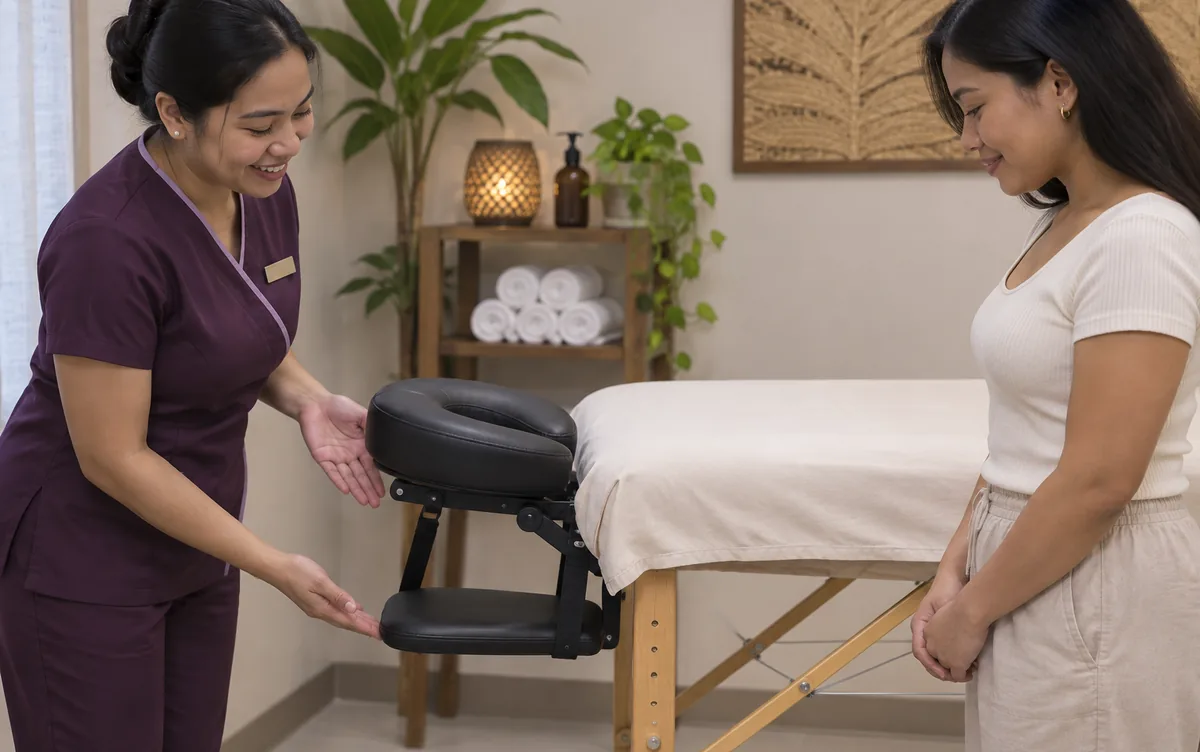
Ten minutes into a massage, you realize your fingers are curled around the edge of the table. Your back may be perfectly comfortable while your arms are quietly working to stay put. Tell the therapist. Where to rest your arms during a massage depends on the table, your position, and what feels easy to maintain with your hands relaxed.
Try a plain description before reaching for a technical word. “My right elbow has somewhere to rest, but my wrist is hanging” tells the therapist much more than “My posture feels wrong.” No photograph of an ideal massage position can tell you how that shelf feels under your own forearms.
Compare the support you can actually feel
Face down, a table might offer space alongside your body, a padded shelf below the headrest, or separate arm supports. The presence of a shelf doesn’t mean its height suits you. Ask the therapist to show it to you before you settle. If your arms rest at your sides, check that your elbows and hands fit without squeezing against your ribs.
On a shelf, notice where your forearms make contact and whether your wrists have to bend to reach it. On a wide table, notice if you’re holding your arms rigid to keep them from slipping. Let your hand go slack for a moment. If the arrangement stops working as soon as you relax, that is a reason to try a different one. Have staff handle the fittings while you are clear of moving equipment.
Adjust each arm independently
Your two shoulders don’t have to vote for the same position. You might enjoy resting one forearm on a padded support and keeping the other nearer your side. Ask whether that combination is workable for the therapist. If you have instructions from a clinician about a particular arm or shoulder, follow them and explain the practical limits before the session.
When the therapist is about to work on a hand or forearm, clarify whether they will lift it or would like you to move it yourself. There is no need to anticipate every movement. “Please let me place my arm when we change positions” can prevent an awkward moment in which both of you try to guide it at once. Describing a massage preference in concrete terms can be especially helpful when one side needs a different approach.
Revisit your hands when you turn face up
An arrangement that worked face down may feel cramped on your back. Pockets, a watch, a high table edge, or simply the weight of a blanket may affect where you want your arms. Ask for help arranging the cover before you reposition. A towel or pillow placed by the therapist can provide a resting surface without your having to clutch the linen.
Some people like their hands resting over their middle. Others would rather leave them at their sides on the table. Either preference can change midway through a session. If your hand goes numb, starts tingling, or hurts, speak up immediately and stop the uncomfortable position. Persistent or unexplained symptoms warrant advice from a healthcare professional.
Leave room for the therapist’s work
The position of an arm can change which part of a shoulder is easily accessible. Ask the therapist to explain any tradeoff before moving you. They might be able to work with your arm where it is, approach from another side, or leave a particular movement out. You can still receive an enjoyable appointment without completing every item on the menu.
For a short appointment, identify which area matters most before spending time testing a complicated setup. The questions in Spakol.net’s massage menu guide help separate a broad service description from the minutes and areas actually available. If you return, ask the therapist to note the support that worked in ordinary language.
A booking decision worked through
A client with a broad shoulder span enjoys face-down back work but has never found a good place to leave both hands during a long session. The deciding priority here is somewhere to rest each forearm without gripping the table.
| Possible arrangement | What the offer includes |
|---|---|
| First option | One table has generous width beside the body, with no separate shelf at the front. |
| Second option | Another has a narrower deck and a padded support below the headrest that the practitioner can demonstrate. |
Before choosing, find out which arrangement permits the hands to rest naturally once the client relaxes. A wider deck may suit someone who likes arms close to the body. A front shelf may be preferable for a client who welcomes that change in shoulder position.
Judge support with an open hand
Make a loose fist, then let your fingers open. The action is small, but it reveals a lot about how the arms are supported. If your hand can rest where it lands, the shelf or pillow may be doing its job. If the fingers immediately curl around an edge or you pull the elbow back to catch the wrist, tell the therapist which part lacks support.
Do the check again when the therapist changes the angle of the headrest or adjusts your position on the table. A shelf attached to another fitting may no longer be where you first tested it. If one forearm slips while the other stays put, look at their separate points of contact before asking for a general increase or decrease in height.
Consider what happens when the covering moves
An arm can be comfortable until a blanket pins it against the edge of the table. If the fabric is the difficulty, moving the actual support may be unnecessary. Ask the therapist to lift or shift the covering and see whether you can let the arm go slack. Check that a loose edge does not repeatedly brush the fingertips if that sensation bothers you.
Some clients want an arm free to signal. Others need an easy way to reach a personal item after sitting up. Say which matters to you. A plan that accounts for the whole appointment includes where the hands will be while resting, how they will move during a change, and how you can use them again when the session ends.
A short arm-support check
- Look at the support before lying down so you understand where the shelf or sides of the table will be.
- Open your hand, soften the elbow, and notice if any part of the arm has to work to remain in place.
- Check again after the headrest, blanket, or body position changes. One arm can have a different resting place from the other.
Who can help you find the right arm support?
The words wide table rarely settle a question about arms. Its width near the elbows, the fittings at the head, and the position you want to use all matter. When comparing two branches, check the actual facilities in the room being reserved. Then ask the practitioner about the position with you on the table.
| Who to ask | What they can establish |
|---|---|
| The person responsible for the table | Whether the arm shelf or side supports are installed and compatible with the specific table. |
| The practitioner | How an arm position affects the areas they can reach and how to support a hand during movement. |
| The person receiving massage | Whether the fingers can stay loose without the arms slipping or being held in place by effort. |
When testing a change, keep the parts already working as they are if possible. Otherwise you may finish the trial unsure whether the improvement came from the new arrangement or from an unrelated change to the room. A brief description of what you actually felt can guide the next decision. Record which arm needed which support instead of remembering only the type of table.
How the same request can play out
When elbows fit but hands hang
Both elbows rest on a shelf, yet the ends of your fingers hang down and you keep curling them upward. A shelf can support an elbow while still asking the wrist and fingers to do unnecessary work.
Is there a broader support that would let my hands rest with my forearms?
Have the practitioner show you the alternatives and try relaxing one hand before deciding.
A table that narrows near the middle
Lying on your back, you have enough room at your shoulders but keep pressing both elbows against your waist. A change of arm position can be simpler than trying to lie unusually straight for an entire appointment.
Could we bring my hands onto a support in front rather than squeezing them at my sides?
Ask the therapist to arrange the covering and try one supported position with your fingers loose.
Unequal preferences
Your left arm is happy on a shelf and your right feels more comfortable resting closer to your body. Some table fittings move independently and other setups need a different approach.
Can each arm have its own resting place while you work on my upper back?
Agree which arm to move first and ask whether the planned shoulder work is still practical.
A change during hand work
You start lifting your arm to help just as the therapist begins guiding it in the opposite direction. A brief instruction avoids two people trying to manage the same movement at once.
Please tell me when you want me to move my arm and when you want me to let it rest.
Pause with the arm supported and choose who will position it for the next part.
Read a studio’s answer about arm supports
Listen for who will do what and when you will be asked for a decision. You can appreciate a helpful offer while asking for one practical detail before agreeing.
What a confirmed option sounds like
The table has a forearm shelf that your therapist can show you while you are standing beside it.
This wording is actionable because the client can inspect and try a concrete piece of equipment.
When the wording leaves room for doubt
“Most people just put their arms where they feel comfortable.” Someone might say this in good faith while thinking of their usual service. The next question brings the conversation back to your visit.
If the shelf or table edge feels awkward, what other resting positions can we try?
An offer with a condition
We have side supports in one room, and we need to check whether they fit the table reserved for you.
In this situation, have the actual room and fittings confirmed before relying on an accessory. Keep the condition attached to the offer when you discuss it with anyone else involved.
A clear way to open the conversation
When I lie face down I tend to grip the table. Can we try the available arm supports and agree how I should move my hands before you begin?
For this request, a useful confirmation identifies where each arm will rest and who will move it during a transition.
A short note for next time
Describe where your forearms rested and how the hands felt once they were fully relaxed. A brief example shows the level of detail to keep.
My left arm was comfortable near my side and my right forearm needed support in front. Please let me move each arm when we switch positions.
One line about each arm is enough for a future visit. The next therapist can see that you wanted space on one side and support in front on the other. Add whether that arrangement changed with a turn, a blanket, or a new headrest position.
Frequently Asked Questions
Do I need to remove a fitness tracker?
Ask whether it will get in the way of the area you booked. If you remove it, keep it with your own belongings and remember to retrieve it before leaving.
Can I keep my hands warm without heating the entire room?
Ask whether a light, dry cover can be placed over your hands. Let the therapist know you would like the rest of the setup kept at its current temperature.
May I hold a small comfort object?
Ask first. A small soft item that you can easily set down may be workable if it doesn’t interfere with the agreed area or require a tight grip.
Can I get a written diagram of the setup for a later appointment?
Ask whether the practitioner can sketch the arrangement without including private records. Keep the sketch with your own notes and allow for different table designs.
Can a sign language interpreter see my hands while I am on the table?
Arrange sight lines with the interpreter and therapist before you settle. You might choose to sit up for conversations that require clear signing.

Try These Massage Packages
HOME + HOTEL SERVICE
(P1,300 + Fare/Transpo)
1 hour and 45 minutes
Whole Body Massage
Body Scrub + Wash
PRIMERO™ Massage Sequence
ALTERRA PACKAGE
(P2,500 + Fare/Transpo)
1 hour + 45 minutes
Whole Body Massage
ALTERRA™ Massage Sequence
Exfoliating Body Scrub + Body Wash
Signature Sensual Massage +
EUFORIA PACKAGE
(P2,750 + Fare/Transpo)
2 hours
Whole Body Massage
EUFORIA™ Massage Sequence
Exfoliating Body Scrub + Body Wash
Signature Sensual Massage ++
INFERNO PACKAGE
(P3,000 + Fare/Transpo)
2 hours + 15 minutes
Whole Body Massage
INFERNO™ Massage Sequence
Exfoliating Body Scrub + Body Wash
Signature Sensual Massage +++
Lingam or Yoni