





















Workplace Chair Massage: How to Run an Office Event People Can Use
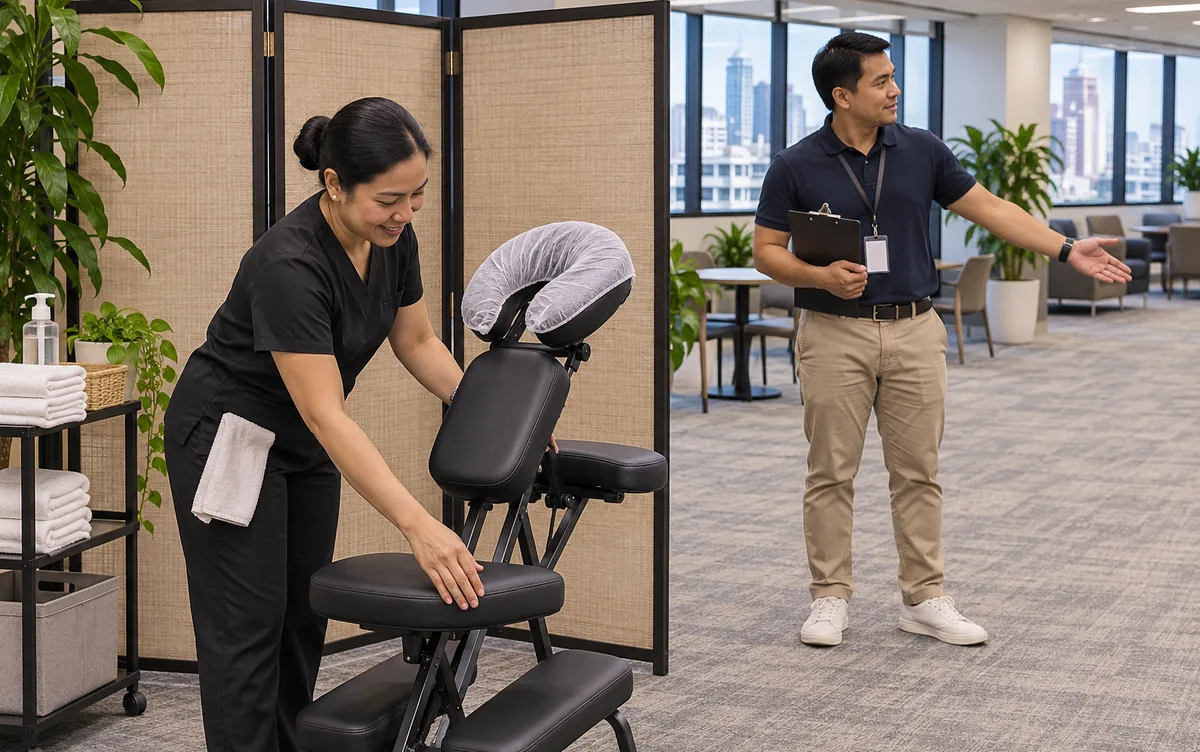
The number that determines an office massage event is rarely the length of the employee list. It’s the number of complete appointments you can fit between the therapist’s arrival and departure, including setup, individual conversations, cleaning, transitions, and practitioner breaks. Build the timetable from those pieces before circulating a sign-up sheet.
Calculate real capacity before offering places
Suppose a provider is on site for two hours. If twenty minutes go to setup and pack-down and ten to a practitioner break, ninety minutes remain. At ten minutes of massage plus five minutes for each changeover, one station can accommodate six clients in that example. Ask the provider to supply its own time estimates before using this arithmetic to promise spaces.
An employee seeing “10:00 to 10:15” may assume fifteen minutes of massage. Label the hands-on time separately from the appointment slot. If several stations operate together, verify the number of practitioners, chairs, and usable spaces. Doubling the number of chairs alone doesn’t double capacity.
Make participation voluntary and the intake private
Ask employees to opt in and choose an available slot without asking them to describe health concerns on a spreadsheet visible to colleagues. Arrange a place for a short private conversation with the therapist. Tell managers that people can decline or release a slot without providing an explanation. Spakol.net’s guide to booking privacy gives examples of information that belongs with the provider rather than a group organizer.
Consider what the chair faces. A station just inside a busy entrance can feel exposed even if it fits perfectly on the floor plan. Leave a route for colleagues who don’t wish to take part, and keep the waiting group far enough away that a quiet conversation remains private.
Schedule for the employees who will actually attend
For a customer service team, ten employees can’t all leave their stations at lunchtime. Ask team leads about cover and stagger starts without handing them private attendance notes. Offer a simple way to release a slot. Keep a voluntary standby list and agree how long a replacement has to reach the room.
A company buying several hours of a professional’s time should confirm setup, breaks, travel, equipment, and what happens if attendance changes. Comparing written massage quotes can help the organizer distinguish an event fee from a charge per participant. Send staff the location, how to dress for a clothed session, and how to contact the organizer if they get delayed.
Compare the appointment you would actually use
An office is planning a wellness afternoon for a team that must keep answering customer calls throughout the event. The deciding priority here is a realistic number of voluntary appointments with cover and private check-ins.
| Possible arrangement | What the offer includes |
|---|---|
| First option | Two therapists can operate at once in a larger room for a shorter event if they each have a chair, space, and agreed breaks. |
| Second option | One therapist can cover a longer series of staggered appointments in a quieter room with a simpler waiting arrangement. |
Before choosing, find out whether simultaneous stations or a longer spread of start times best matches staff availability. A larger headcount on paper is less valuable than slots employees can actually attend. Privacy and staff coverage can favor the slower timetable even when both quotes fit the budget.
Put setup, cleaning, and staff cover on the same timetable
An employee booking sheet shows only the visible appointments. Make a second, working version for the organizer and provider that also includes building entry, equipment setup, time to check the room, station cleaning, practitioner breaks, and pack-down. Assign an owner to the tasks that depend on your office, such as unlocking a meeting room or moving an ordinary conference table. The practitioner should not have to spend their first ten paid minutes searching for facilities staff.
Run a small rehearsal on paper. If the fourth employee arrives late, does the practitioner work a shortened appointment, leave the slot open, or call a standby person? Who tells the next employee the real start time? Choose the rule in advance and tell employees what they need to know. A fair rule is easier to apply than a last-minute exception offered to the person with the most senior job title.
Decide what the organizer needs to measure
For a repeat event, you might want to know how many slots were offered, how many were used, whether staff could reach the room, and what times were most popular. You don’t need private treatment notes to answer those operational questions. An optional question such as “Which time window would you use again?” can be more useful to next month’s schedule than a broad satisfaction score.
Ask the practitioner separately whether the room and intervals allowed them to work comfortably. Their answer may reveal a noisy waiting line, a cramped reset, or a timetable that looked efficient only from the office manager’s desk.
Create a schedule employees can read without consulting the organizer
Publish the information a participant actually needs. Give the room name and reliable route, the time to arrive, the full duration of the slot, the portion intended for hands-on work, and whom to contact if they cannot attend. A list that contains only names and start times may conceal five minutes of changing over or send a colleague to the wrong floor. Make sure people coming from a distant part of the building have enough time to reach the room.
Give the practitioner a different version with what they need, such as station numbers, breaks, setup access, and the person authorized to handle schedule changes. Leave employee health or intake information off both versions. If two people swap, the organizer needs to know who is expected when. They do not need to know why either person wanted the original appointment.
- Put a realistic final time on each wave, including the practitioner’s break and the final station reset.
- Identify the seat or waiting point for the next employee separately from the place for a private intake.
- Tell employees whether a missed or released slot goes to a standby person or remains an empty interval.
Afterward, compare the first appointment with the last. If the first started on time and the last started twenty minutes late, look for small delays that accumulated with every guest. A longer changeover might improve the next event more than adding a chair. If the delays all occurred at the building entrance, the organizer can fix access before changing the treatment schedule.
Who owns each part of the event schedule?
A workplace organizer can reserve space, but only the provider can confirm how many safe, complete appointments its staff can deliver. The employees make their own decisions about taking part. Questions about fresh linens, contact surfaces, and products belong in the provider discussion before the first sign-up email goes out.
| Who to ask | What they can establish |
|---|---|
| The office organizer | Room access, team cover, practical sign-ups, and how an employee can release a place. |
| The event provider | Staff capacity, setup time, cleaning intervals, working space, and practitioner breaks. |
| Each participant | Their own choice to participate, preferred contact, and private answers to the therapist. |
A change announced to one participant can affect other people who never saw the message. Identify the person who needs the update and pass on the logistical information relevant to them. Private choices, intake details, and personal reasons generally do not belong in a shared timetable. Attendance is easier to interpret when the organizer also knows which time slots staff realistically could use.
What to do when the first plan changes
A misleadingly full sign-up sheet
The organizer has divided two hours into back-to-back massage minutes and left no time for reset or breaks. A schedule that treats every minute on site as hands-on time is already late before the first employee arrives.
How many complete slots can your practitioners actually offer once setup, changes, cleaning, and breaks are included?
Recalculate the slot count with the provider and release only places the agreed plan can deliver.
A team that cannot leave together
Several employees from the same service desk select neighboring times that would leave nobody covering customer requests. A voluntary event works better when it fits each team’s real coverage responsibilities.
Which appointment starts can we stagger while keeping your personal booking details private?
Give the team a choice of feasible windows and arrange a discreet way to exchange slots.
A queue with an audience
A line forms behind the chair where colleagues can hear each participant’s conversation with the therapist. A corner can appear private on a floor plan and lose that privacy once a line forms.
Where can the next person wait without hearing someone else’s check-in?
Move the waiting point and invite one person at a time through the screen.
A late release between meetings
An employee cancels near the start of a slot, and a colleague on standby works several floors away. Filling every opening has less value if people rush and the remainder of the event falls behind.
How much notice does a standby participant need to arrive without shortening the therapist’s next slot?
Offer the place to a reachable volunteer or use the gap for a reset without shortening later bookings.
What an event quote tells the office organizer
Read the reply against the original request. If it answers a related question but leaves your essential point open, a short, factual follow-up can move the conversation forward.
A specific answer
Our quote covers two staffed chairs, scheduled reset time, one practitioner break per station, and a private intake point.
You can use this answer because the organizer can use the actual stations and intervals to calculate dependable capacity.
Where a detail is missing
“We can massage the whole office in the afternoon.” This could be an invitation to keep talking. One specific follow-up is usually easier to answer than asking for the entire menu or policy again.
How many complete appointments can you deliver with your available practitioners, and how long is each changeover?
What a conditional answer means
We can add another station if you can provide a second screened space with enough room to work.
In this situation, verify the room before inviting additional employees to sign up. An alternative only becomes your plan once you have heard the relevant details and chosen it.
A message you can adapt
Can you quote for complete chair massage appointments, including setup, transitions, and practitioner breaks? We need a schedule that allows the team to stay staffed and check in privately.
For this request, a useful confirmation identifies the stations, hands-on time, changeover interval, breaks, and sign-up capacity.
A short note for next time
Keep the station timetable, coverage contact, and private check-in arrangement alongside the event quote. For example, a private note might read as follows.
Next time put the waiting point outside the screen and stagger the service desk team. The advertised appointment slot included changeover as well as hands-on minutes.
After the event, record whether the problem was the number of chairs, the time between clients, or the way people reached the room. A precise observation such as “staff on the fourth floor needed five more minutes to arrive” is more valuable for the next event than a broad comment that the day was busy.
Frequently Asked Questions
Can employees who work remotely join the same benefit?
Ask your benefits team about a comparable option. Access to a company event and reimbursement for an individual appointment may follow different rules.
May the company photographer take event photos?
Seek separate, genuine permission from everyone identifiable and arrange a photo-free area. Participation in massage should never depend on appearing in publicity.
Who supplies extension cords or other electrical equipment?
Ask the provider what it actually needs and coordinate with facilities. A manual chair massage station may only require suitable floor space and light.
Can the organizer publish employees’ satisfaction comments?
Obtain separate permission for identifiable quotes. An anonymous, optional feedback form can serve planning needs without publishing personal experiences.
Should a standby employee pay a fee to hold a spot?
Check the company’s arrangement with the provider. Explain any employee cost before sign-up and avoid inventing a fee for an employer-funded service.

Try These Massage Packages
HOME + HOTEL SERVICE
(P1,300 + Fare/Transpo)
1 hour and 45 minutes
Whole Body Massage
Body Scrub + Wash
PRIMERO™ Massage Sequence
ALTERRA PACKAGE
(P2,500 + Fare/Transpo)
1 hour + 45 minutes
Whole Body Massage
ALTERRA™ Massage Sequence
Exfoliating Body Scrub + Body Wash
Signature Sensual Massage +
EUFORIA PACKAGE
(P2,750 + Fare/Transpo)
2 hours
Whole Body Massage
EUFORIA™ Massage Sequence
Exfoliating Body Scrub + Body Wash
Signature Sensual Massage ++
INFERNO PACKAGE
(P3,000 + Fare/Transpo)
2 hours + 15 minutes
Whole Body Massage
INFERNO™ Massage Sequence
Exfoliating Body Scrub + Body Wash
Signature Sensual Massage +++
Lingam or Yoni